
Reviewed · GRAN CANARIA SURF LESSONS
Surf Gran Canaria : Premium Surf Lessons for All Levels
Gran Canaria waves make first lessons feel easy. What makes Surf Gran Canaria click is the hands-on coaching and the built-in 2 hours on the water that turn nerves into actual rides.
I really like the way the instructors work on your basics on land first, so you learn the right movement instead of guessing. My second favorite part is how you get steady in-water feedback with your instructor beside you, not just a quick check at the start.
One consideration: your ride to the beach is not included in the base price, and the team may switch beaches based on tides and weather, so the day plan can flex.
In This Review
- Key things I’d mark on your map
- Gran Canaria surf lessons that feel built for real progress
- Meeting at the shop, getting geared up fast
- Warm welcome, stretching, and a safety-first approach
- Beach training: pop-up, balance, and wave positioning
- Two hours in the water with continuous feedback
- How tides and weather decide the beach
- Price and value: what $77 buys you in real surfing terms
- What to bring, and what can ruin your day
- Who this surf lesson suits best, and who should skip it
- Small group energy, big coaching effect
- The cool-down and debrief, where you leave smarter
- Should you book Surf Gran Canaria Premium Surf Lessons?
- FAQ
- How long is the full surf lesson in Gran Canaria?
- What’s included in the price?
- Do I get picked up from my hotel?
- What languages do the instructors speak?
- Are the lessons only for beginners?
- Where do we meet for the lesson?
- What should I bring to the surf lesson?
- How does the schedule work with tides and weather?
Key things I’d mark on your map
- All levels, same care: beginners and more advanced surfers get coaching geared to their level.
- Beach-to-water structure: you start with safety and pop-up technique on sand before you go in.
- Safety gear included: surfboard plus a leash, and you get a rash guard (lycra) for comfort.
- Coaching with feedback in motion: you practice, then get tips while you’re in the water.
- Spot choice matters: they schedule around tides and weather and may use different beaches for best conditions.
- Photo bonus: you get free photos from the group lessons.
Gran Canaria surf lessons that feel built for real progress
Surfing in Gran Canaria sounds like a big dream. This experience makes it feel more like a skill-building day than a random try-it-and-hope situation. The team runs premium lessons for all levels, so the day isn’t only aimed at people who have never stood on a board. If you’ve surfed before, you still benefit from targeted corrections.
I also like the teaching pace. Instead of throwing you into the ocean and hoping you catch on, the instruction has clear stages: warm-up, beach fundamentals, theory on safety, then guided water time with ongoing coaching. That structure helps your brain do two things at once: learn what to do and start doing it while it still feels learnable.
And it’s not a long, exhausting ordeal with endless waiting. The total activity runs about 4 to 5 hours, with 2 hours in the water. You’ll likely feel tired in the good way by the end, not drained from sitting around.
Other lessons on the island breaks:
- Playa del Inglés Maspalomas: High Quality Surf Classes★ 4.9 · 363 reviews
- Puerto Rico, Gran Canaria: boat trip, drinks, food, paddle surfing, snorkeling★ 4.6 · 310 reviews
- Gran Canaria Maspalomas: Surf lessons all levels★ 5.0 · 197 reviews
Meeting at the shop, getting geared up fast
The meeting point is the surf shop. That matters because you avoid the awkward scramble of trying to find someone with a board bag later. At the shop, you’ll pick up what you need and get a briefing that sets expectations for the day.
You’ll get the basics of what to wear and how safety works before anything touches the water. The included setup includes:
- Surfboard
- Safety leash on the surfboard
- Lycra rash guard
- Introduction to safety
- Theory lesson on the beach
- Instructor-led coaching
- Water, plus a chocolate or energy bar
That’s a strong package for the price because you are not responsible for tracking down gear or paying extra for the minimum equipment most schools require. You just show up in beachwear and sunscreen, then get ready.
Also, instructors can teach in English, Italian, or Spanish. If language is part of your comfort level, that flexibility helps.
Warm welcome, stretching, and a safety-first approach
The day starts with a friendly intro from your instructors. You’ll get a comprehensive introduction to the equipment and safety measures before you hit the waves. This is the part that makes the rest of the lesson feel safer and more confidence-building.
Then you’ll do stretching and warm-up exercises. Surfing uses legs, hips, and your upper body for paddling and pop-up. If you skip warming up, you pay for it later with stiff muscles and clumsy movement. This lesson takes care of that.
The safety portion is not just a formality. You’re given the basics so you understand why the leash matters, how waves and currents behave, and what your role is in the line-up. When instructors explain this clearly on land first, you spend more of your brain power on timing and balance once you’re in the water.
Beach training: pop-up, balance, and wave positioning
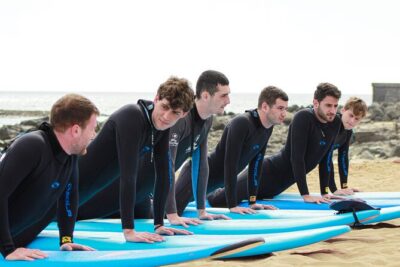
Before you’re in the ocean, you’ll do beach training. This is where beginners often improve the fastest because you can try the movement without fatigue or wave chaos.
On the sand, the coaching focuses on:
- Pop-up mechanics (the sequence from lying to standing)
- Balance on the board
- Positioning yourself so you’re set up for the next wave
I like this part because it turns surfing into a set of repeatable actions. You’re not just learning how to stand. You’re learning how to stand at the moment a wave gives you a chance.
If you’re nervous about your first attempt, beach coaching lowers the fear level. You can practice the steps while the instructor is giving feedback face-to-face. You also get a sense of what they mean by cues like knees bent, eyes forward, and stable weight.
One detail I’d pay attention to: the lesson includes a theory lesson on the beach, so you’re not only copying movements. You’re also learning why your body position matters for catching waves and staying controlled.
Other things to make by hand on Gran Canaria:
Two hours in the water with continuous feedback
Now for the part you came for. After the beach segment, you go into the water with your instructor by your side. The lesson includes water time of 2 hours, and that guidance is not limited to once-and-done instruction.
You’ll get:
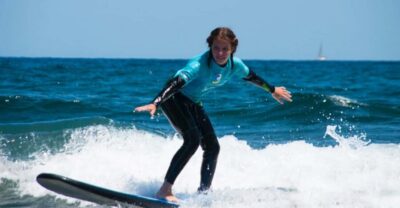
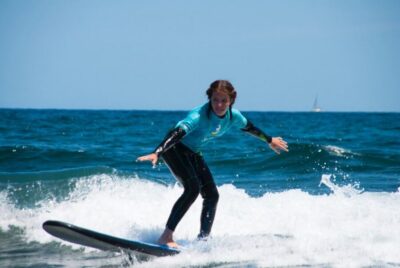
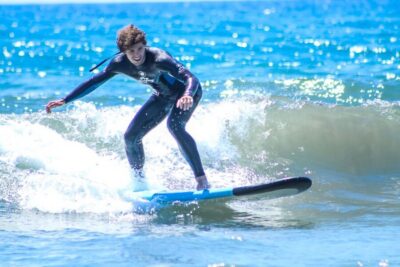
- Guided assistance to catch your first waves
- Continuous feedback as you practice
- Coaching aimed at building confidence, not just technical perfection
This is where the private-group style really helps. You’re getting a close coaching ratio compared with typical large group formats, and you’re less likely to feel lost.
A nice detail from real instruction moments shared by participants: instructors like Dani are known for teaching first on the sand, then encouraging and assisting once you’re paddling out. That two-stage approach is exactly what you want for learning speed and motivation.
In the water, your biggest challenge will be timing: paddling hard, then popping up at the right moment. Good coaching helps you fix timing issues sooner, which means you spend more of your session catching waves rather than restarting in frustration.
How tides and weather decide the beach
Gran Canaria surf is not one fixed postcard spot. The team schedules lessons based on tides and weather conditions, aiming for the best experience that day. You might also need to visit different beaches to match the surf.
This matters because the conditions can change quickly along the island. Some days are great for calmer, learning-friendly waves. Other days may require a different area with safer, more manageable surf for your level.
So, if you’re trying to plan a perfect day with strict timing, build in some flexibility. The lesson is scheduled around the ocean, not around a rigid itinerary line on a map.
For you, the upside is simple: you’re more likely to get waves that fit your skill level and safety needs. That’s better than forcing everyone into one spot when conditions are not ideal.
Price and value: what $77 buys you in real surfing terms
At $77 per person for a 1-day surf lesson, the question is not just the sticker price. It’s what you’re getting for that money and what you avoid.
You get most of the hard-to-manage parts covered:
- Board and safety leash
- A rash guard
- Safety intro plus theory on the beach
- Instructor-led lessons with hands-on feedback
- 2 hours in the water
- Water and a snack (chocolate or energy bar)
- Free photos on the group lessons
- A shuttle bus option to the beach
One important pricing note: pickup is not included in the base price. If you need shuttle bus service, it’s available for an additional €15, and that fee covers the entire group (up to 8 people).
So the real value depends on where you’re starting from. If you can easily get to the shop meeting point yourself, you may keep costs tight. If you need transport, factor in that €15 for the group, not per person.
Also, the lesson duration is about 4 to 5 hours total. You’re not paying for a quick 30 minute “look at this” session. You’re paying for a structured half-day of coaching plus two hours of focused practice.
What to bring, and what can ruin your day
You’ll have a much smoother lesson if you arrive prepared. The basics are:
- Biodegradable sunscreen
- Comfortable clothes for warm-up and beach time
- Beachwear
What to avoid matters too. The activity lists a number of items not allowed. Common “keep it simple” rules include:
- No high-heeled shoes
- Pets are not allowed (assistance dogs are allowed)
- No drones
- No weapons or sharp objects
- Don’t bring oversize luggage
There are also vehicle rules like no smoking in the vehicle and no drinks in the vehicle, plus a general rule against littering. If you want this to feel easy, pack light and keep things practical for sun, sand, and water.
Who this surf lesson suits best, and who should skip it
This one is built for all skill levels, which is good if you’re in a mixed group. You’ll still share the same core lesson structure, but coaching is geared to where you are: beginner trying your first pop-up, or returning surfer sharpening technique.
Where I’d be careful is the list of unsuitability conditions. The activity is not for a wide range of situations and body limits, including:
- Pregnancy
- People with back problems, heart problems, epilepsy, respiratory issues
- Wheelchair users and people with mobility impairments
- Non-swimmers
- People prone to seasickness
- A long list of age and weight limits (for example, children under certain ages, and weight cutoffs such as under 66 lbs are listed)
If you have a medical condition, it’s worth checking carefully before booking. Even if you feel okay, the physical demands of paddling, falls, and wave impact might not match your situation.
If you’re generally healthy, a non-swimmer, or you’re under the listed age or weight ranges, I’d look for a different surf program with options that fit your needs.
Small group energy, big coaching effect
The lesson format is a private group. That detail is quietly important. It usually means less waiting, fewer people for instructors to manage at once, and better chances of personalized corrections.
And you still get the “group lesson” perks like free photos. It’s a nice mix of individual coaching plus a little social memory at the end.
Expect the instructors to keep things fun, not just technical. The lesson includes stretching, beach practice, in-water guidance, a cool-down, and a debrief. That debrief is where you often learn what you should practice next time back home, instead of just walking away confused.
The cool-down and debrief, where you leave smarter
After the water time, there’s a cool-down and a debrief with your instructor. This is not filler time. It’s where the day becomes a skill you can carry forward.
You’ll get insights and recommendations for further improvement. If you’re like most first-timers, you’ll remember the feeling of standing or the moment you caught your first wave, but you might not fully understand why it worked. The debrief helps connect the movement you practiced with what to focus on next time.
If you’re returning, the debrief can give you a sharper target too, like adjusting stance, improving timing, or learning how to position yourself before you paddle.
Should you book Surf Gran Canaria Premium Surf Lessons?
Book it if you want a surf day that is structured, safety-focused, and built around coaching. The strongest reason to choose it is that the lesson gives you the full pipeline: safety and theory on the beach, then beach training for the pop-up and positioning, then 2 hours in the water with continuous feedback.
Skip or double-check the fit if you have restrictions listed for medical conditions, pregnancy, wheelchair use, non-swimming ability, or if you fall outside the age or weight limits. Also, if transport is an issue for you, remember that pickup is not in the base price, and the shuttle is €15 extra per group if you need it.
If you’re trying surfing for the first time, this is the kind of setup that makes learning feel fast and rewarding. If you’ve surfed before, it’s still worth it because the coaching aims to refine what’s going wrong, not just get you on a board.
FAQ
How long is the full surf lesson in Gran Canaria?
The total experience is about 4 to 5 hours, depending on tides and weather. You also get 2 hours on the water.
What’s included in the price?
You get a surfboard, a safety leash, a rash guard (lycra), safety introduction, a beach theory lesson, instructor coaching, water, and a chocolate bar or energy bar. You also receive free photos on the group lessons.
Do I get picked up from my hotel?
Pick-up is not included in the base price. If you need transport, a shuttle bus service is available for €15 for the whole group (up to 8 people).
What languages do the instructors speak?
Instructors teach in English, Italian, and Spanish.
Are the lessons only for beginners?
No. The lessons are designed for all levels, from complete beginners to more advanced surfers.
Where do we meet for the lesson?
You meet at the shop, where you’ll pick up the equipment and get a briefing with details for the day.
What should I bring to the surf lesson?
Bring biodegradable sunscreen, comfortable clothes, and beachwear.
How does the schedule work with tides and weather?
Lessons are scheduled based on tides and weather conditions to give you the best experience. You might also go to a different beach if conditions change.
Just added on Gran Canaria
- Family Monster 4 Seater Buggy
★ 5.0 · 1 review - Flying Dress Photoshoot in Gran Canaria
★ 5.0 · 1 review - Catamaran Eco Tours in Gran Canaria
★ 5.0 · 1 review - Cheese Workshop
★ 5.0 · 1 review - Canarian cheese tasting
★ 5.0 · 1 review - Private Transfer Gran Canaria Port to Gran Canaria Airport (LPA)
★ 5.0 · 1 review
Gran Canaria Surf Lessons, compared.
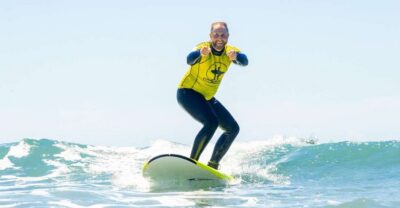
Playa del Inglés Maspalomas: High Quality Surf Classes
Read our review →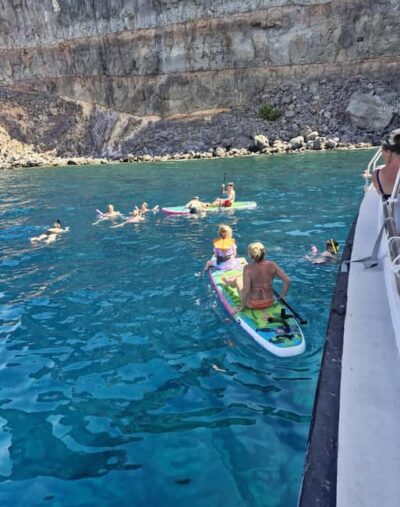
Puerto Rico, Gran Canaria: boat trip, drinks, food, paddle surfing, snorkeling
Read our review →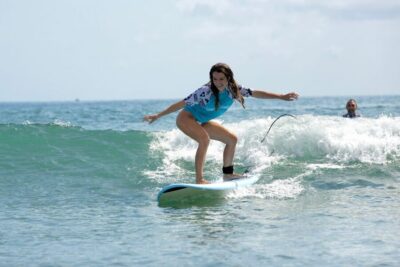
Gran Canaria Maspalomas: Surf lessons all levels
Read our review →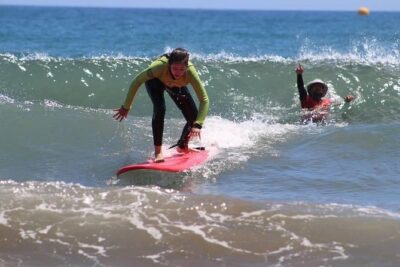
Gran Canaria Surf Lessons: Playa del Inglés & Maspalomas
Read our review →Browse the lists this tour appears in